
The Messenger / Louvre: The Final Curse
| The Messenger | ||
|---|---|---|
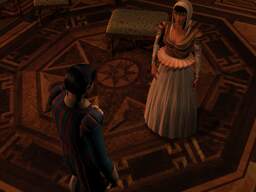
| ||
| First release | 2000 | |
| Also known as | The Final Curse | |
| Developed by | Arxel Tribe | |
| Published by | Canal+ Multimedia, Wanadoo Edition, Réunion des Musées Nationaux DreamCatcher Interactive | |
| Distributed by | Various | |
| Platforms | Windows, Macintosh, PlayStation | |
| Resolution | 640x480, 16-bit color | |
| Engine | PhoenixVR | |
| Support | Since ScummVM 2026.4.0 | |
| Available for Purchase |
Yes | |
The Messenger (original French title: Louvre: L'Ultime Malédiction, "Louvre: The Final Curse") is an adventure game released in Europe in 2000, and in North America in February 2001. It was co-developed by 4x Technologies, Arxel Tribe and Visual Impact and jointly published by Wanadoo Edition, Canal+ Multimedia and the Réunion des Musées Nationaux.
The Secret Service Agent Morgane Sinclair has been charged with the mission to retrieve four mystical artifacts called Satan's Keys from the Louvre Museum. These four keys, when joined together, cause complete global annihilation. Morgan goes back in time to three periods in time when various kings used the Louvre as their residential palaces: Charles V Mediaeval period, Henry IV Renaissance period, Louis XV 1789 French Revolution period, and then return safely to present day. In this race against evil and against time, she needs to find the keys before the vengeful descendants of an evil cult of Black Templars combine these mystic artifacts, triggering Armageddon.
The game uses a Myst-like first-person perspective. The player explores panoramic locations, collects and combines items, solves puzzles, and takes part in several action sequences.
Engine
The original Windows releases use the PhoenixVR engine.
The PlayStation and classic Macintosh release are not supported.
Installation
Required data files
For more information on how ScummVM uses game data files, see the user documentation.
Windows (Retail CD release)
For CD releases, you’ll need to follow a specific folder structure. Create a folder (for example, louvre) with two subfolders named cd1 and cd2. Copy the entire contents of CD1 into cd1 and CD2 into cd2, preserving the original folder structure on each disc. Then click Add Game in ScummVM and select the louvre folder containing both subfolders.
Other releases
PlayStation and Macintosh releases are not supported.